
The Posture and Pain Research Is More Complicated Than You Were Taught — Here's What Ergonomists Need to Know
May 20, 2026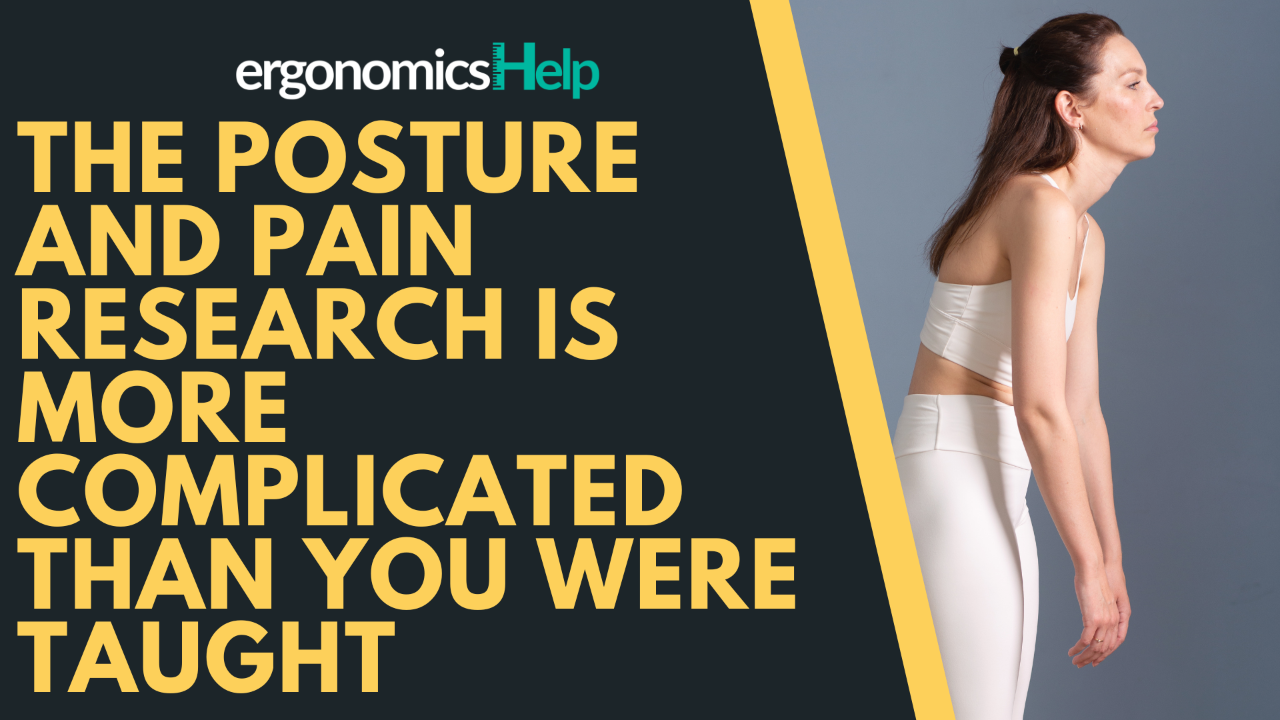
Ask almost any ergonomics professional what causes neck pain in a screen-heavy workforce and you'll hear some version of the same answer: forward head posture. The chin juts out, the head migrates forward of the shoulders, and the muscles and joints of the cervical spine take a beating. Fix the posture, fix the pain.
It's an intuitive model. It's been reinforced through years of workplace wellness training, postural correction programs, and assessment frameworks. And two studies published in April 2026 are asking us to revisit it — carefully, precisely, and with some real clinical humility.
This post is for ergonomics consultants who want to stay at the leading edge of the research — not because it's interesting, but because the practitioners who know this are having fundamentally different conversations with clients than the ones who don't.
Finding One: Forward Head Posture Doesn't Reliably Predict Neck Pain
A cross-sectional study published in Gait and Posture in April 2026 compared 50 adults with chronic neck pain against 42 asymptomatic controls. Researchers used photogrammetric craniovertebral angle (CVA) measurement — a validated, photograph-based method for quantifying how far the head sits forward of the vertical — in both sitting and standing positions. Novice raters were used to assess reliability, and the method performed well.
Here's what they found:
No association was found between forward head posture and chronic neck pain in this young adult cohort. The factors that did predict neck pain were female sex and being overweight — not craniovertebral angle. (Rodríguez-Romero et al., 2026, Gait & Posture)
Before drawing conclusions, the caveats matter: this is a cross-sectional design, so causal claims aren't warranted. It's in young adults, which limits generalizability to older workers. And the overall literature on forward head posture and pain is genuinely mixed — some studies find a relationship, many don't.
What this finding does is add to a growing body of evidence that the causal link between head position and neck pain is weaker and less direct than the conventional model implies. The clinical implication isn't that posture doesn't matter — it's that explaining neck pain through posture alone, or designing interventions primarily around achieving a specific head position, is probably insufficient.
For ergonomics consultants, the reframe is this: when recommending monitor height adjustments, chair recline, or headrest modifications, the mechanism you're targeting isn't 'the posture looks wrong.' It's sustained muscle load, end-range joint exposure, and the absence of movement variability. Those are the actual risk factors. Framing your recommendations in those terms positions you as the clinical expert — not the posture police.
And when a client comes to you having attended a wellness webinar that told them posture is the answer, you have the nuance they don't. That's a credibility conversation, and the research hands it to you.
Finding Two: Text Neck Patients Show Less Muscle Activity, Not More
The second study is the one that genuinely stopped me. A case-control EMG study published in the Journal of Electromyography and Kinesiology in April 2026 examined 40 participants — 18 with text neck syndrome, 22 without — using bilateral surface electromyography of the upper trapezius and abductor pollicis brevis (a thumb muscle active during texting and swiping), alongside neck disability scores, hand grip strength, and posture assessment.
As expected, the text neck group had significantly higher smartphone use and texting time. But the EMG finding inverted the standard model:
Symptomatic text neck users showed significantly LOWER muscle activity than controls in the dominant abductor pollicis brevis (p=0.011), dominant upper trapezius (p<0.001), and non-dominant upper trapezius (p=0.008). The people in pain had less muscle activation, not more. (Yasaci et al., 2026, Journal of Electromyography and Kinesiology)
This directly challenges the 'muscle hyperactivity causes pain' framework that underlies a significant amount of text neck intervention design. Stretching protocols, posture cues, break reminders — these are all predicated on the assumption that the problem is overactivation. Too much work. Reduce the load and relieve the muscle.
But if symptomatic users are showing muscle inhibition rather than hyperactivity, the problem is underwork. Deconditioning. The neck and shoulder musculature of high-frequency smartphone users may be losing capacity over time, not being overloaded.
The intervention implication is substantial: a deconditioning problem requires progressive loading and capacity-building, not just stretching and rest. Neck stability training. Shoulder girdle strengthening. Load-tolerance exercises. These are a different program than what most workplace wellness offerings include.
The authors also found that abductor pollicis brevis activation correlated with smartphone duration, neck disability index scores, and postural misalignment — confirming that screen time, muscle behavior, and disability are related. The relationship is just working through a different mechanism than most people assume.
What Both Findings Point To: The Combined Intervention Advantage
These two studies sit alongside a third major finding from the April 2026 literature that ties the clinical picture to the business case.
An integrated review published in Workplace Health and Safety examined seven studies across six countries, covering combined ergonomic and physical activity interventions for work-related MSD prevention. The evidence synthesis was clear:
Combined ergonomic plus physical activity interventions produced a 38% reduction in neck pain and a 37% reduction in hand and wrist pain. Education-only programs were identified as the weakest single approach. Whole-body stretching achieved greater pain reduction than education-only programs. Intervention durations ranged from 6 weeks to 22 months. (Adebiyi et al., 2026, Workplace Health & Safety)
Thirty-eight percent. From a multi-country, multi-study review. The mechanism makes sense when you consider the EMG finding: if the problem for screen-heavy workers is partly deconditioning and reduced muscle capacity, then ergonomic modifications alone — without any physical conditioning component — are addressing only part of the problem.
The posture finding reinforces this too. If postural correction alone isn't sufficient, the intervention needs to target load management, movement variability, and physical capacity. That requires both environmental modifications (ergonomics) and physical conditioning (exercise programming or physiotherapy). The research supports what many experienced practitioners have known intuitively: the answer is rarely just one thing.
Three Things to Do With This in Your Practice — This Week
1. Audit Your Posture Narrative
If your reports and assessments currently frame forward head posture as a primary driver of neck pain, the research is asking you to refine that. Not abandon it — refine it.
The more accurate framing is load management, movement variability, and muscle capacity. A recommendation to adjust monitor height is valid — but the mechanism is reducing sustained end-range cervical load and enabling more movement, not achieving a specific head position. That framing is more accurate, more defensible, and honestly more impressive to a client who understands clinical reasoning.
2. Upgrade Your Service Offering
The combined intervention evidence is a genuine business case for expanding or partnering beyond assessment-only services. If your current offering stops at the ergonomic assessment and report, you're delivering the weaker evidence-based intervention.
Options: expand your scope if your background supports it (physical therapy, kinesiology, exercise science backgrounds are highly relevant here), or partner with a physiotherapist, kinesiologist, or exercise physiologist who can deliver the conditioning component. The outcome for the client is better. The contract is longer — six weeks to 22 months, not a one-time assessment. And the evidence you can cite to justify the program scope is now peer-reviewed and multi-country.
When a client says 'we already do ergonomics training,' you have a precise answer: education-only programs are the weakest single approach in the evidence base. Combined programs produce 38% reductions in neck pain. Which approach does yours use?
3. Turn This Into Content
These findings are LinkedIn posts. They're the opening of a sales conversation. They're the reason a prospect says: I didn't know that — tell me more.
- Forward head posture doesn't reliably predict neck pain in young adults — and what that means for your ergo program
- Text neck patients have less muscle activity, not more — and why your stretch card isn't enough
- Why 38% of your neck pain problem could be addressed — if you're using the right type of program
Each of those is a post. Each of those is an email subject line. Each of those starts a conversation that positions you as the practitioner who is actually reading the current research — not the one who learned ergonomics a decade ago and hasn't looked back.
The competitive advantage isn't knowing more than your clients. It's knowing more than the ergonomists who haven't kept up. And in a field where most practitioners are too busy to read the journals, a monthly literature review and a podcast on your commute is genuinely enough to stay at the front.
That's what this is for.