
Exoskeletons in the Workplace: Evidence-Based Framework or Expensive Band-Aid?
May 11, 2026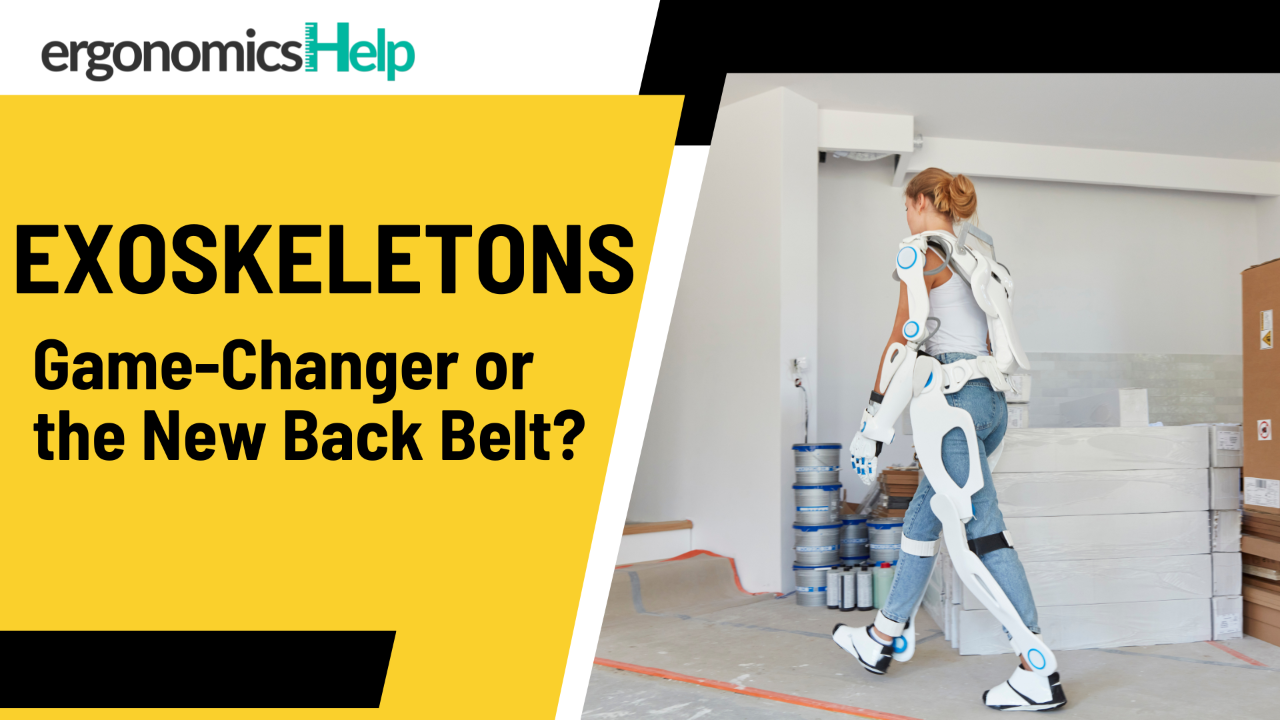
Exoskeletons are the hottest topic in occupational health technology right now. The pitch is compelling: put a wearable device on your workers, reduce muscle load, prevent injuries. Problem solved.
Except it isn't. And as ergonomics professionals, I think we have an obligation to say so (loudly and clearly), before this technology becomes as entrenched as the back belt. Because if you've been in this field long enough to remember the back belt era, you know exactly how this story can go.
Let me walk you through the evidence. All of it, not just the parts the device manufacturers put in their brochures.
The Back Belt Story We Need to Remember
Back belts migrated from medical rehabilitation and competitive weightlifting into industrial manual material handling workplaces in the late 1980s and 1990s. The logic seemed sound: if a belt supports the spine under extreme load in a gym, it must protect warehouse workers too.
NIOSH formed a Back Belt Working Group in 1992 to find out. Their 1994 review found insufficient evidence to recommend back belt use as a workplace injury prevention measure. They then conducted the largest prospective cohort study of its kind, following material handlers in a large retail setting from 1996 to 1998. The results, published in the Journal of the American Medical Association in 2000, were clear: back belt use was not associated with any reduction in back injury claims or low back pain.
NIOSH's formal conclusion: Back belts should not be considered personal protective equipment and should not be recommended for occupational use. Their concerns included: no evidence of reduced spinal pressure during lifting, potential reduction in muscle suppleness over time, and creation of a false sense of security that may encourage lifting heavier loads. (NIOSH, 2000; JAMA, 2000)
The term researchers used for that false sense of security was the 'superman effect', the belt makes you feel invincible, so you lift heavier, and when the belt comes off you are potentially at greater risk than before.
Here's the part that should stop us cold: nearly four million back belts were purchased in 1995, the year after the first NIOSH findings. And you can still find them at Home Depot today.
The industry felt the solution was logical. The marketing was persuasive. The evidence was inconvenient. Sound familiar?
What Exoskeletons Can Do and What the Research Actually Shows
To be fair to the technology: exoskeletons are not back belts. They are more sophisticated, more varied, and some of the research is genuinely promising.
There are two main categories in occupational settings. Passive exoskeletons use springs or elastic mechanisms to redistribute load, no power source required, lighter, cheaper. Active exoskeletons use motors and actuators powered by a battery, heavier, more expensive, but capable of dynamic real-time support that passive devices can't provide.
A 2023 peer-reviewed study measured EMG (electromyographic) activity, the electrical signal of muscle contraction, in workers performing manual material handling tasks with and without back-support exoskeletons. Active exoskeletons reduced muscle activity in key structures like the erector spinae, latissimus dorsi, and gluteus maximus by 7 to 62% compared to no device. That's real offloading. One study found that a back-support exoskeleton reduced the perceived weight of a handled object by 37.5%, a 20kg box felt like 12.5kg.
In surgical settings, surgeons reported up to 70% reduction in shoulder pain during prolonged procedures. In nursing contexts, 86% of users in one study reported reduced back pain and fatigue during patient care tasks.
The signal is real. The technology is not a fraud.
But here's what you need to know about the research base before you recommend this technology to a client.
A comprehensive 2024 systematic review of 49 exoskeleton studies (2014–2024) found that laboratory-based studies dominated the research landscape. The most common sample size was 10 participants. The research base is heavily weighted toward short-term, controlled-setting evaluations. Long-term, real-world, large-sample data is still sparse. (Cardoso et al., 2024, IJERPH)
Ten participants. In a lab. That is the foundation on which a lot of exoskeleton deployment decisions are being made right now.
Five Concerns Every Ergonomist Should Raise Before Recommending an Exoskeleton
1. Risk Transfer, Not Risk Elimination
Exoskeletons are designed to offload specific muscles during specific movement patterns. What they can also do is shift load to other structures. Research on lower-limb exoskeletons has found that positioning the device with the knees in an excessively extended position for sustained periods may transfer health risk from the back to the knees. Bosh et al. (2016) raised this concern explicitly.
When you reduce load on one structure without eliminating the hazardous task, you don't eliminate the risk, you just redirect it. A thorough ergonomic assessment would anticipate this. Deploying the device without that assessment means you may find out the hard way.
2. The Donning and Doffing Problem
Manufacturers often cite 30–60 seconds for donning an exoskeleton. That sounds manageable, until you account for a production environment where workers move between different task types throughout a shift, where time pressure is real, and where the device may need to come off and go back on multiple times per hour.
Research consistently identifies donning and doffing time as a significant barrier to exoskeleton adoption. In construction settings, the additional time required reduces productive work time and creates pressure to wear the device for tasks it wasn't designed for — which introduces new risks. (Schwerha et al., 2021; PMC, 2025 systematic scoping review)
Incompatibility with mixed or dynamic task profiles is one of the most frequently cited adoption barriers across the literature. A device that doesn't get worn is not an ergonomic intervention. It's an expensive storage problem.
3. The Enthusiasm Effect and the Drop-Off
Frontiers in Public Health research noted something important about long-term exoskeleton use: when subjective experience was measured over time, satisfaction and perceived benefit decreased after an initial enthusiastic evaluation. Workers were excited about the novelty. That excitement faded as fit issues, thermal discomfort during sustained use, and the practical burden of managing the device in a real work environment became apparent.
If compliance decreases over time, so does the protective effect. A device that's well-used in week one and rarely used in month six isn't a sustainable safety intervention.
4. Overreliance and the Band-Aid Effect
This is the concern that most directly echoes the back belt story. CCOHS has published explicit guidance on exoskeleton overreliance:
'Consider the potential for overreliance on exoskeleton technology... Exoskeletons should not be the only control measure used to create ergonomic work environments. Combine exoskeletons with control measures at the source, engineering controls, and administrative controls to provide a full and layered approach.' (CCOHS, 2022)
The real-world risk is that organizations purchase exoskeletons, feel they've addressed the ergonomic problem, and stop asking the more difficult questions: Can the lift be eliminated? Can the height be adjusted? Can the load be reduced? Can a mechanical assist replace manual handling entirely?
The exoskeleton becomes the band-aid that prevents the wound from being properly treated.
5. The Lab-to-Workplace Gap
Most exoskeleton research is conducted in controlled laboratory settings, with small samples, over short periods, and with standardized tasks. Real workplaces involve variable loads, time pressure, multi-task environments, temperature extremes, diverse worker populations, and eight-hour shifts. The translation from lab to field is not guaranteed and the systematic scoping review published in PMC (2025) was explicit that long-term, real-world research is still needed to support safe and effective exoskeleton implementation.
Where Exoskeletons Fit: The Hierarchy of Controls
In occupational health, we use the hierarchy of controls to evaluate intervention options from most effective to least: elimination, substitution, engineering controls, administrative controls, and PPE.
Exoskeletons function at the PPE level. They augment the worker. They do not change the job, the environment, or the hazard. Deploying them before working through the hierarchy above them is not best practice — it is the opposite of best practice.
Before an organization reaches for an exoskeleton, the ergonomic assessment should have genuinely explored:
- Elimination: Can this task be automated or eliminated entirely?
- Substitution: Can a mechanical lift assist, conveyor, or pallet jack with a lift table replace the manual handling?
- Engineering controls: Can the lift height be adjusted so workers aren't lifting from the floor or above shoulder height? Can load weights be reduced? Can carrying distances be shortened?
- Administrative controls: Can task rotation, reduced frequency, and recovery time reduce cumulative exposure?
A lift table that adjusts a pallet to working height eliminates the hazardous lifting zone. It costs a fraction of an exoskeleton fleet. It doesn't require charging. It doesn't need to be put on and taken off. And it doesn't rely on worker compliance to work.
When those options have been genuinely explored — not dismissed, but evaluated and found to be infeasible — then and only then is the exoskeleton conversation the right one to be having.
When Exoskeletons Do Make Sense
There are specific contexts where exoskeletons are a genuinely valuable tool:
- Tasks with fixed elevation requirements that cannot be engineered away, sustained overhead assembly, specific surgical postures, certain maintenance tasks where the physical constraint is inherent to the environment
- Environments where the task profile is consistent enough that the device can be worn for meaningful periods without frequent donning and doffing
- Workforces where the anthropometric fit range of the device matches the actual worker population, a device that doesn't fit properly is a hazard, not a solution
- Programs that include a full evaluation framework: discomfort surveys before and after deployment, compliance tracking, adverse event monitoring, and a defined review point
- Situations where engineering and administrative controls have been genuinely exhausted and the residual risk still warrants a layered approach
Exoskeletons as one layer in a comprehensive, properly-assessed ergonomics program? Potentially valuable. Exoskeletons as the ergonomics program? That's where we have a problem.
What This Means for Your Practice
If a client approaches you about exoskeleton implementation, here is the framework I'd recommend:
- Start with a thorough ergonomic risk assessment and discomfort survey. Establish your baseline. Know where the risk actually lives before you decide how to address it.
- Work through the hierarchy of controls systematically and document what you've evaluated and why higher-order controls were or weren't feasible.
- If exoskeletons enter the conversation, evaluate device fit for your specific population, task compatibility, donning/doffing requirements, and what the monitoring and evaluation plan will look like.
- Build the cost comparison explicitly: engineering control cost vs. exoskeleton fleet cost vs. projected injury cost without intervention. The ROI case needs to be made on real numbers.
- Never deploy any technology without a pre-intervention baseline and a defined post-intervention evaluation point. If you can't measure the effect, you can't make the case — and you can't course-correct if something goes wrong.
The worker who goes home without a back injury deserves an intervention that was grounded in a thorough evaluation of their actual risk — not in what was available in the procurement catalogue, and not in what looked impressive in a trade show booth.
Fix the job first. Layer in technology where it genuinely adds value on top of a proper foundation.